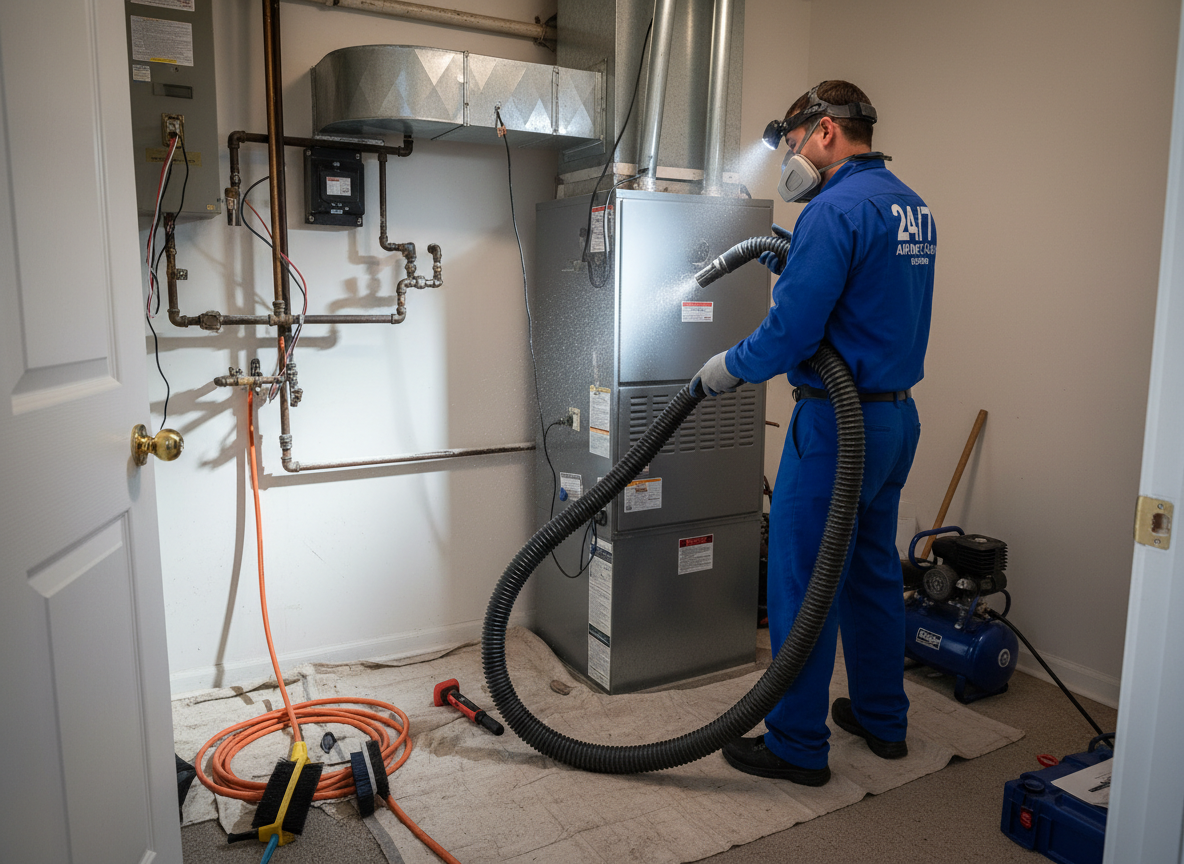
Mint Hill sits in Mecklenburg County with a humid subtropical climate that brings hot, sticky summers and mild winters. This weather pattern keeps pollen and moisture moving through ducts year-round, especially in neighborhoods like Bainbridge and The Farm at Mint Hill where mature trees surround many homes. Flexible duct runs in crawl spaces and attics trap fine red clay dust and organic debris that standard filters miss, leading to reduced airflow and musty odors when the AC cycles heavily in July and August.
Homes built from the 1970s through the 1990s around Mint Hill Veterans Memorial Park often have original metal trunk lines with flexible branch runs that sag or separate over time. Tight attic access and low crawl spaces common on these lots make full cleaning slower than in newer Charlotte subdivisions. Technicians must work around insulation, electrical runs, and occasional knob-and-tube wiring without disturbing the structure, which changes both the time on site and the tools required compared with open commercial work.
Twenty-four-hour service becomes necessary after sudden humidity spikes or when residents notice allergy flares during the brief winter warm-ups. A single clogged return near the furnace can push particles through the entire system once the heat kicks on. Crews dispatched from 7710 Matthews-Mint Hill Rd respond with portable HEPA equipment sized for residential trunks rather than large commercial rigs, allowing work inside occupied homes without major disruption even at 2 a.m.
Technician insight
In Mint Hill, the thing that catches most people out with 24/7 Air Duct Cleaning is how the mild winters still let pollen and fine red clay dust keep settling in older duct runs around Bainbridge and The Farm at Mint Hill. Homeowners often wait until summer humidity spikes before calling, then discover the real restriction is a single sagging flex line in a low crawl space that only shows up once negative pressure is applied.
Middle-of-the-night call after heavy rain
A Bainbridge homeowner reported sudden musty air and weak airflow the night after a summer storm. Inspection showed water had entered an attic return through a loose seam, carrying clay and leaf debris into the main trunk. Crews isolated the section, removed the saturated material, and restored full airflow before morning so the family could run the AC without recirculating damp air.
How it works
- 1
Initial Assessment
Technician arrives and inspects accessible ducts, registers, and the furnace or air handler to identify blockages and material types before any equipment is brought inside.
- 2
System Isolation
Vents are sealed and negative pressure is established so debris pulled during cleaning does not escape into living spaces.
- 3
Mechanical Cleaning
Rotary brushes and compressed air tools dislodge buildup from trunk lines and branches while HEPA vacuums capture the material at the source.
- 4
Final Verification
Registers are reopened, airflow is checked at multiple points, and the homeowner receives a walkthrough of findings and any recommended next steps.
Pricing
Upfront quotes based on square footage, number of runs, and access difficulty; no hidden fees after work begins.