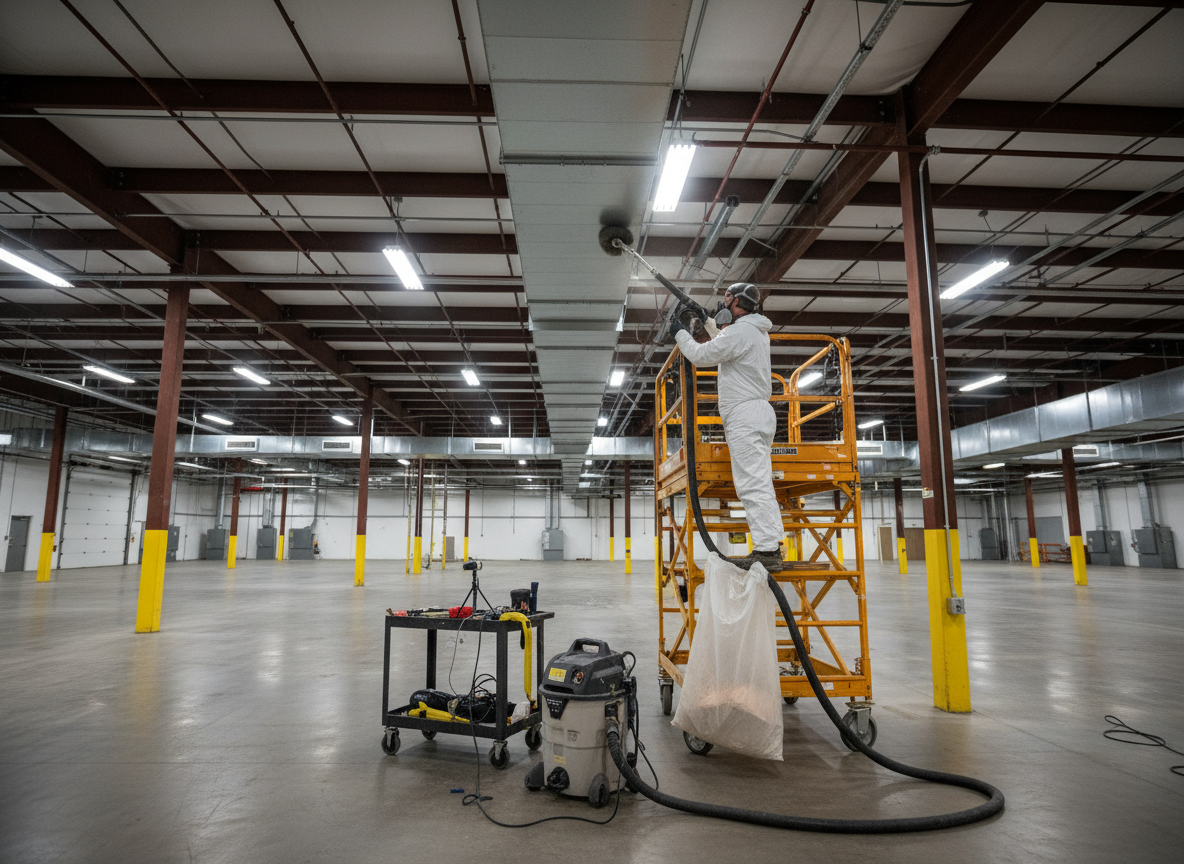
Commercial buildings in Mint Hill and nearby Bainbridge often feature older galvanized or flexible duct runs installed during the area's growth from Charlotte spillover. In Mecklenburg County's humid subtropical climate, hot summers drive condensation inside supply lines while mild winters allow dust and pollen to settle without full system cycling. This combination creates sticky biofilm layers that standard residential tools cannot reach in larger trunk lines serving retail spaces or offices near Mint Hill Veterans Memorial Park.
Access challenges appear frequently in The Farm at Mint Hill commercial strips where drop ceilings and rooftop units sit above tenant spaces with limited entry points. Technicians must isolate zones to avoid disrupting operations, using negative-air machines sized for the square footage rather than home setups. Failure to map return paths correctly can push contaminants into occupied areas, especially when pollen counts spike from surrounding open land during spring.
Mecklenburg building practices sometimes leave unsealed joints in older commercial HVAC that allow moisture intrusion from roof leaks common after heavy summer storms. Cleaning crews inspect for these gaps before agitation to prevent water from being pulled into the airstream. Post-clean verification focuses on airflow readings at diffusers rather than visual checks alone, since residual moisture can restart mold growth within weeks if humidity levels stay elevated.
Technician insight
In Mint Hill the thing that catches most people out with Commercial Air Duct Cleaning is how the mild winters let pollen and construction dust from nearby Charlotte development settle deep in long horizontal runs without triggering the system enough to move it. Rooftop units serving strip centers near The Farm at Mint Hill then pull that load straight back into the space once summer humidity hits and condensation starts.
Retail Strip Center Ducts
A Mint Hill retail building showed reduced airflow and musty odors after a wet spring. Inspection found heavy pollen and dust packed in the main trunk serving three storefronts. Crew isolated each tenant space, agitated the lines from rooftop units, and extracted the load. Airflow readings returned to design specs and odor complaints stopped.
How it works
- 1
Site Assessment
Walk the commercial property to map all trunk lines, returns, and rooftop units while noting access restrictions and tenant schedules.
- 2
Zone Isolation
Set up containment barriers and negative pressure to protect occupied spaces in buildings around Bainbridge and Mint Hill.
- 3
Agitation and Extraction
Use rotary brushes and compressed air tools sized for commercial ducts followed by HEPA vacuum extraction of loosened debris.
- 4
Final Verification
Measure post-clean airflow at multiple diffusers and inspect for remaining moisture before restoring full system operation.
Pricing
Commercial pricing requires on-site inspection because duct length, access height, and number of zones vary widely between Mint Hill properties.