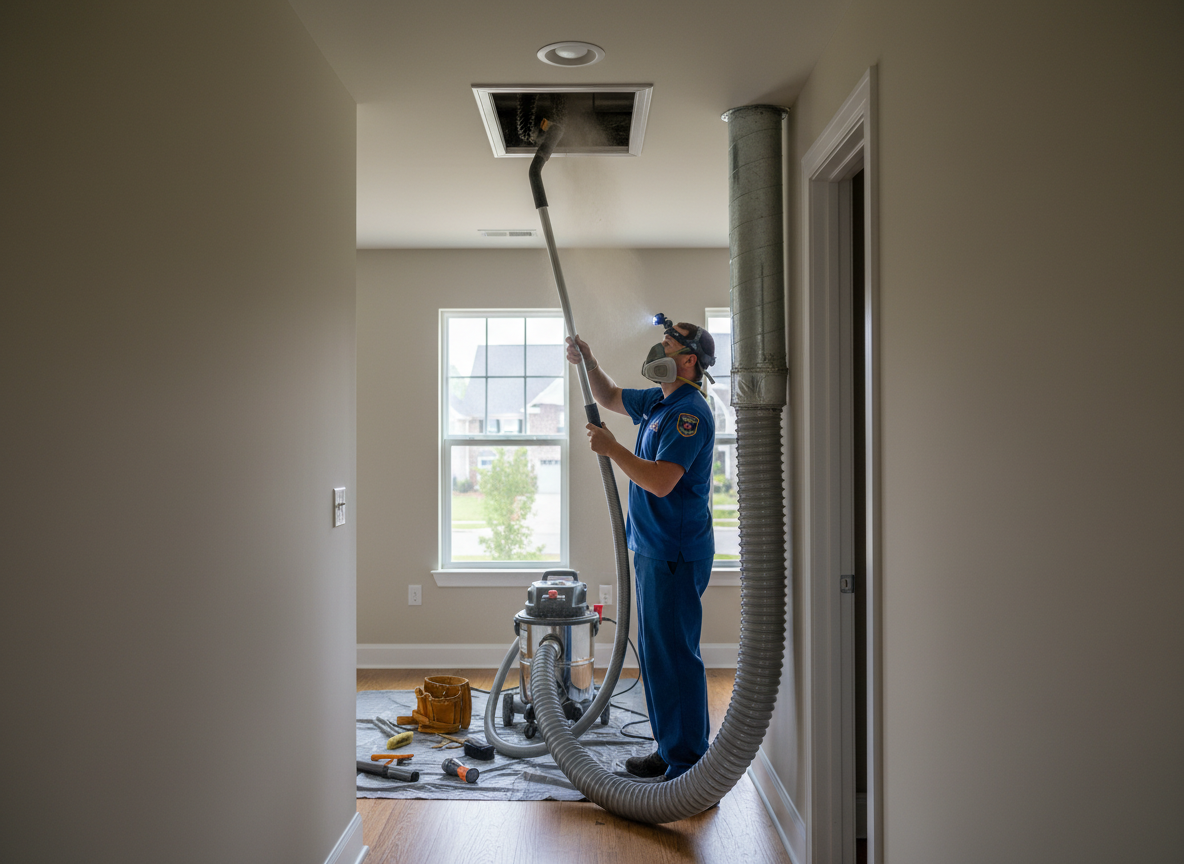
Mint Hill sits in Mecklenburg County with a humid subtropical climate that drives heavy summer pollen and moisture into ductwork. Homes in neighborhoods like Bainbridge and The Farm at Mint Hill often feature older forced-air systems where condensation mixes with oak and ragweed pollen, creating hidden mold colonies along trunk lines and branch runs. Technicians must account for the mild winters that never fully dry the system, leaving residual moisture that standard dry-brush methods miss. Working from the shop at 7710 Matthews-Mint Hill Rd allows quick response across the area without long travel that lets loosened debris resettle.
Edge cases appear regularly in Mint Hill’s split-level and ranch homes built before 1990. Narrow flex duct sections near the air handler trap debris that rigid trunk lines push past during normal airflow. Negative-pressure machines must be balanced carefully so attic insulation is not pulled into returns, especially when access panels sit close to vaulted ceilings common in The Farm at Mint Hill. Crews also check for disconnected boots at exterior walls where red-clay soil shifting has created gaps that let humid air leak back into the system.
Before any cleaning begins, supply and return registers are sealed and the furnace or air-handler blower is isolated to prevent cross-contamination into living spaces. A HEPA-filtered vacuum is attached at the main trunk while rotating brushes and compressed-air whips dislodge buildup without damaging duct seams. Final inspection includes a borescope check of the plenum and a particle-count reading at the farthest register to confirm the system has returned to baseline cleanliness levels typical for Mecklenburg County homes.
Seasonal Guidance
Hot, humid summers accelerate mold growth inside ducts while mild winters keep systems running constantly, circulating pollen year-round. Scheduling service after peak ragweed season in early fall prevents immediate re-loading of freshly cleaned lines.
Technician insight
In Mint Hill, the thing that catches most people out with Residential Air Duct Cleaning is how the red-clay soil around Bainbridge homes shifts crawlspace ducts just enough to create hidden gaps; those gaps let humid air back in and undo the cleaning within a single summer unless the boots are resealed during the job.
Bainbridge Split-Level Job
Homeowner noticed musty smell from vents after a wet summer. Inspection found mold on flex runs where soil settling had opened a gap near the foundation. Crew sealed the boot, cleaned the entire system under negative pressure, and confirmed baseline particle counts before restoring airflow.
How it works
- 1
Site Assessment
Technician maps every accessible duct run, notes flex sections, and checks for moisture stains or disconnected boots common in Mint Hill homes.
- 2
Containment Setup
Registers are sealed, the air handler is isolated, and negative pressure is established to keep debris from entering living areas.
- 3
Mechanical Cleaning
Rotating brushes and air whips remove buildup from trunk lines and branches while the vacuum captures loosened material.
- 4
Verification
Borescope inspection and post-clean particle counts confirm ducts meet cleanliness standards before equipment is restored.
Pricing
Cost depends on total linear feet of duct, number of flex runs, and access difficulty; upfront quote provided after assessment.