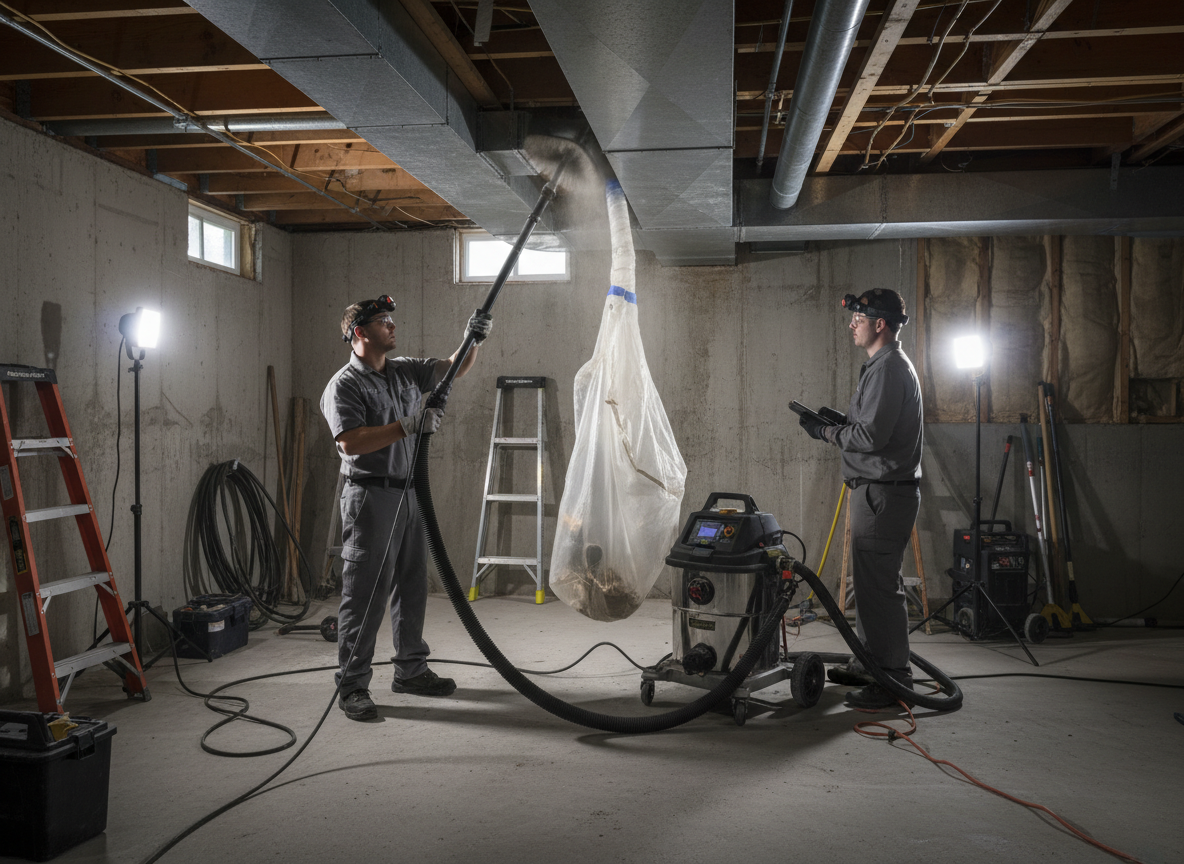
Basements in Mint Hill homes, especially those in established neighborhoods like Bainbridge, often trap humidity from the region's subtropical climate. This leads to condensation along metal duct runs that sit close to cool slab floors or exterior walls. Over time pollen, dust, and fine soil particles from nearby construction and farm land settle in these lower sections, restricting airflow and feeding microbial growth that standard whole-home cleanings overlook. Technicians must isolate the basement trunk lines, use negative pressure equipment sized for the smaller volume, and check for insulation gaps that allow moist air to reach the ducts during mild winters.
Homes near Mint Hill Veterans Memorial Park and along Matthews-Mint Hill Road frequently date from the 1970s through 1990s, when builders ran rigid metal ducts directly through unconditioned basements without vapor barriers. The combination of hot summers and mild winters keeps relative humidity elevated year-round, so moisture lingers inside the ducts even when the HVAC is off. Cleaning crews therefore start with moisture readings and camera inspections before agitation, then apply EPA-registered antimicrobial treatments only where visible biofilm is confirmed rather than as a blanket step.
Charlotte's rapid growth has increased traffic-related particulates that infiltrate Mint Hill basements through unsealed penetrations. When ducts run parallel to foundation walls, road dust mixes with occasional groundwater seepage common in Mecklenburg clay soils. Proper cleaning requires sealing off supply and return boots at each register, followed by a final HEPA vacuum pass to capture dislodged material before the system is restarted. Homeowners in The Farm at Mint Hill often request this service after noticing uneven cooling on the main floor caused by restricted basement returns.
Technician insight
In Mint Hill, the thing that catches most people out with basement air duct cleaning is how our humid summers and mild winters let moisture sit in the lower ducts of 1980s homes in Bainbridge, creating hidden biofilm along slab edges that only shows up once you isolate the basement zone.
Bainbridge Basement Ducts
Homeowner reported musty air on the main floor during summer. Inspection showed condensation and pollen accumulation in the basement trunk lines of a 1987 home. Crew isolated the zone, performed negative-pressure cleaning, and verified removal with post-job camera footage. Airflow improved and the odor did not return.
How it works
- 1
Site Assessment
Technician inspects basement layout, measures duct runs, and checks humidity levels against local climate norms before any equipment is brought inside.
- 2
Isolation and Access
Supply and return lines are sealed at registers and the furnace; access panels are opened only where needed to reach trunk lines without disturbing finished spaces.
- 3
Agitation and Extraction
Rotary brushes and compressed air move debris toward a HEPA-filtered vacuum while negative pressure prevents particles from escaping into living areas.
- 4
Final Verification
Post-clean camera inspection confirms removal of visible buildup; system is restarted and airflow is checked at each basement register.
Pricing
Pricing based on basement square footage, number of runs, and condition found during inspection; quotes provided on site before work begins.