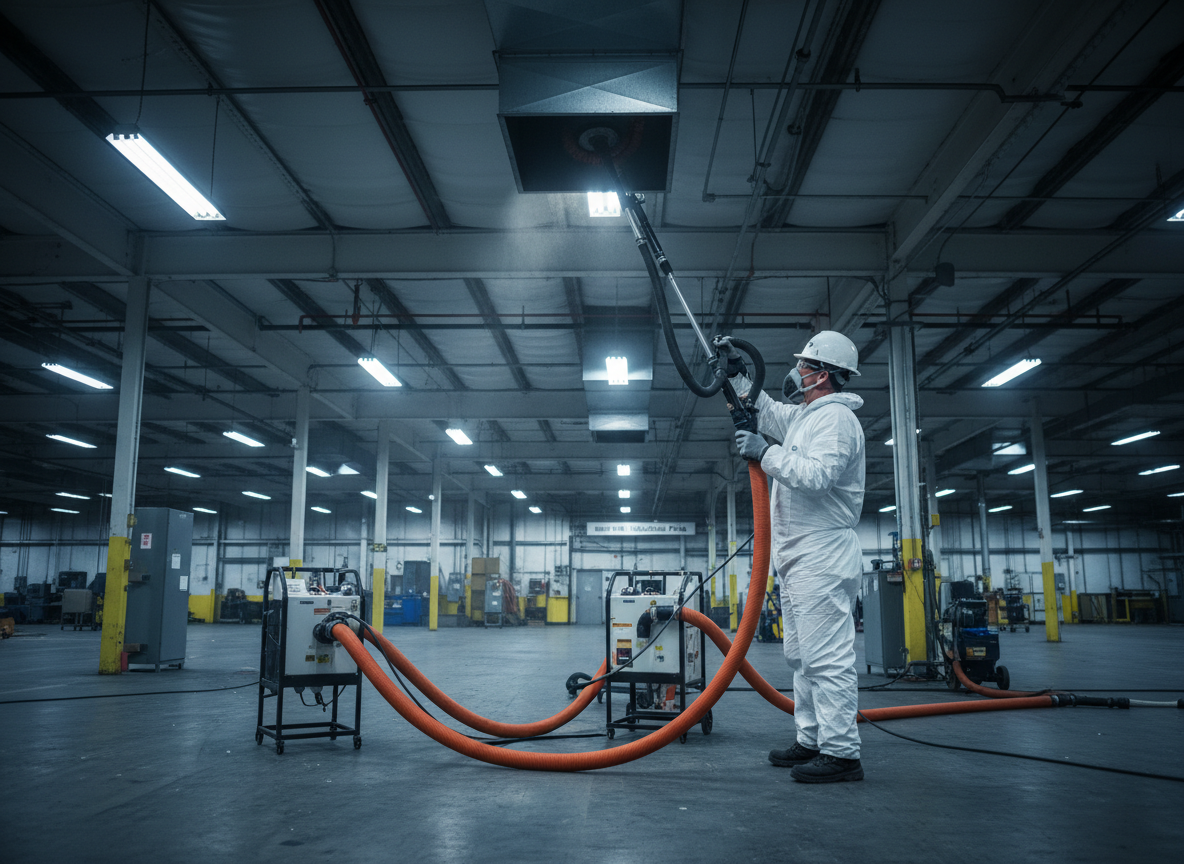
Mint Hill's humid subtropical climate brings hot summers that drive condensation inside large industrial duct runs, especially in facilities near Bainbridge and The Farm at Mint Hill. This moisture combines with pollen and construction dust common in Mecklenburg County to create thick biofilm layers that standard residential equipment cannot reach. Industrial systems often run longer hours than residential ones, so neglected buildup raises energy costs and risks contaminant recirculation into workspaces. Technicians must account for roof-mounted units and multi-story trunk lines typical of commercial buildings in the area.
Many industrial sites in Mint Hill sit in older commercial stock built before current Mecklenburg County ventilation standards, with access panels that have been painted over or blocked by equipment. Terrain around Mint Hill Veterans Memorial Park includes slight elevation changes that affect condensate drainage in long horizontal runs. Crews routinely encounter mixed-material ducts where metal transitions to flexible sections, requiring different agitation tools to avoid damage. Proper negative-pressure containment is essential to keep dislodged debris from entering adjacent tenant spaces.
Industrial cleaning here also means working around active production schedules. Crews coordinate shutdown windows with facility managers to minimize downtime while still achieving full source removal. In Charlotte-adjacent zones, heavier truck traffic adds an extra layer of fine particulate that settles in intake plenums. Final verification includes airflow measurements at multiple registers to confirm restored performance rather than relying on visual inspection alone.
Technician insight
In Mint Hill, the thing that catches most people out with Industrial air duct cleaning is the pollen load that builds up during our mild winters when systems never fully shut down. Buildings near The Farm at Mint Hill often have long horizontal runs with poor drainage that trap moisture year-round, turning a standard cleaning into a multi-day containment job.
Warehouse System Near Bainbridge
A distribution warehouse in Bainbridge reported inconsistent airflow and visible dust on product shelves. Inspection revealed heavy pollen and construction residue packed in the main trunk lines serving the loading area. Crews set up full negative-air containment and performed mechanical agitation followed by extraction. Airflow measurements returned to design specs and the facility resumed operations the next shift.
How it works
- 1
Site Evaluation
Technicians inspect all accessible trunk lines, branches, and rooftop units while noting access points and any code-related obstructions in the Mecklenburg County building.
- 2
Containment Setup
Negative-air machines with HEPA filtration are positioned at key points to isolate the work zone and prevent cross-contamination into occupied industrial spaces.
- 3
Mechanical Agitation and Extraction
Rotary brushes and compressed-air whips loosen debris along the full length of the system while vacuum collection removes material at the source.
- 4
Post-Cleaning Verification
Airflow readings and visual checks confirm restored performance before equipment is returned to normal operation.
Pricing
Pricing varies by system size, number of access points, and extent of contamination; upfront quotes provided after evaluation.